
Year-End Series · Part 2Part 1: Close Out the Year Clean
Start prepping now
A step-by-step guide to the DEA biennial inventory for veterinary practices
The biennial inventory is a short document with a long reach: when an investigator reviews your controlled substances, it’s where the math starts. Here’s what to record, how to run count day, and the misses we see most often.
The short version
- Count at least every two years, at the opening or close of business, and write down which.
- Count Schedule II exactly. Open Schedule III–V containers can be estimated, with one exception.
- Reconcile before anyone signs, then start the new year from the count.
Why start now?
In our year-end checklist, the count was step four of five. Everything before it is prep, and that takes weeks, not hours.
- Now: pick your date and counters
- Early December: reconcile your log
- The week before: map every location
- Dec 31 or Jan 1: count, compare, and sign
VetSnap users: skip the worksheet. Biennial counts and a printable inventory sheet are built into your account.
Why the biennial matters, and why January 1
Federal rules require a complete inventory of every controlled substance on hand at least every two years, on any date within two years of your last one (21 CFR 1304.11). That flexibility is why so many biennials land mid-year and mid-logbook.
The date matters because an investigator’s math is simple:
Starting inventory + what you received − what you used, wasted, or disposed of = what should be on the shelf.
Your biennial is that starting inventory. Count at close of business December 31 or opening of business January 1, and it lines up with your logbook year, your purchasing year, and how a reviewer reads twelve months of activity. Counted in the last two years? You can still take a new one now and reset to the calendar.
From the field
A wildlife facility counted everything on January 1 and kept its log current. When its audit came, the review needed three documents: purchase records, the log, and that count. They matched. No reconstruction, no digging.
What goes on the biennial
A biennial is only as good as what’s written on it. Here’s what to capture.
At the top of the record
- The date of the count.
- Opening or close of business. The rule requires you to state which (21 CFR 1304.11(a)).
- The registrant’s name, DEA number, and signature. Reviewers look for these first, and they’re the most often missing.
For every controlled substance
- Drug name, dosage form, and strength.
- Units or volume per container, and the number of containers.
- Opened containers: an exact count or measure for Schedule II. Schedule III–V can be estimated, unless the container holds more than 1,000 tablets or capsules (21 CFR 1304.11(e)).
- Stock awaiting disposal, with the quantity and why it’s being held.
Every location on your registration. Main and satellite storage, surgery, refrigerators, crash carts, mobile units, and vehicles.
How to keep it
- File Schedule II records separately. Schedule III–V can be separate or readily retrievable (21 CFR 1304.04).
- Keep it at least two years at your registered location, longer if your state requires it.
- Check your state rules. Some require more, like annual counts. Follow the stricter rule.
Count day, step by step
From the audit side · Former DEA Supervisory Special Agent
The count goes fast when the prep is done.
”
Most of the work happens before count day. Here’s the routine he recommends to the practices he audits.
Now
- Pick your date and counters. Close of business December 31 or opening of business January 1. Name two people, ideally including the DEA registrant.
Early December
- Reconcile your log. Resolve flagged entries, close out empty containers, log pending waste, and match every delivery to its invoice.
The week before
- Map every location, including expired stock waiting on a reverse distributor.
Count day
- Count by schedule. Exact for Schedule II. Estimates for open III–V containers of 1,000 or fewer tablets or capsules. For liquids, use a vial-size gauge or a weight-based count instead of drawing up.
- Compare before you sign. Find and document any difference first. A biennial that disagrees with the log is a discrepancy with a signature on it.
- Sign the record. Date, opening or close of business, registrant name, DEA number, and both counters’ signatures.
First week of January
- Start fresh from the count. Use it as the new year’s opening balance, and file it with your invoices, DEA Form 222s or CSOS records, and any Forms 41 or 106.
The misses we see most often
Most practices do count. The trouble is usually a detail on the record.
| The miss | The fix |
|---|---|
| No opening or close of business noted | Write which, every time. |
| Missing name or signature | Registrant name, DEA number, and signature on every count. |
| Signed while the log disagrees | Resolve differences before anyone signs. |
| A location left out | Map every spot first, including the mobile kit and the fridge. |
| Estimates on Schedule II | Exact count or measure, always. |
| A biennial no one can find | File it with your purchase records. |
Aim for a perfect record, every count. Small fixes, made every day, are how you get there.
How VetSnap makes the biennial simpler
Biennial counts are built into your Digital DEA Logbook, with your log balances already filled in.
Your biennial in three steps
- Create a Physical Count. Print the inventory sheet if you count on paper.
- Enter your counts. Totals compare to your log automatically.
- Choose Biennial, add both signatures, and Sign Off.
Then the new year starts from the count. Balances carry forward automatically.


Your biennial toolkit
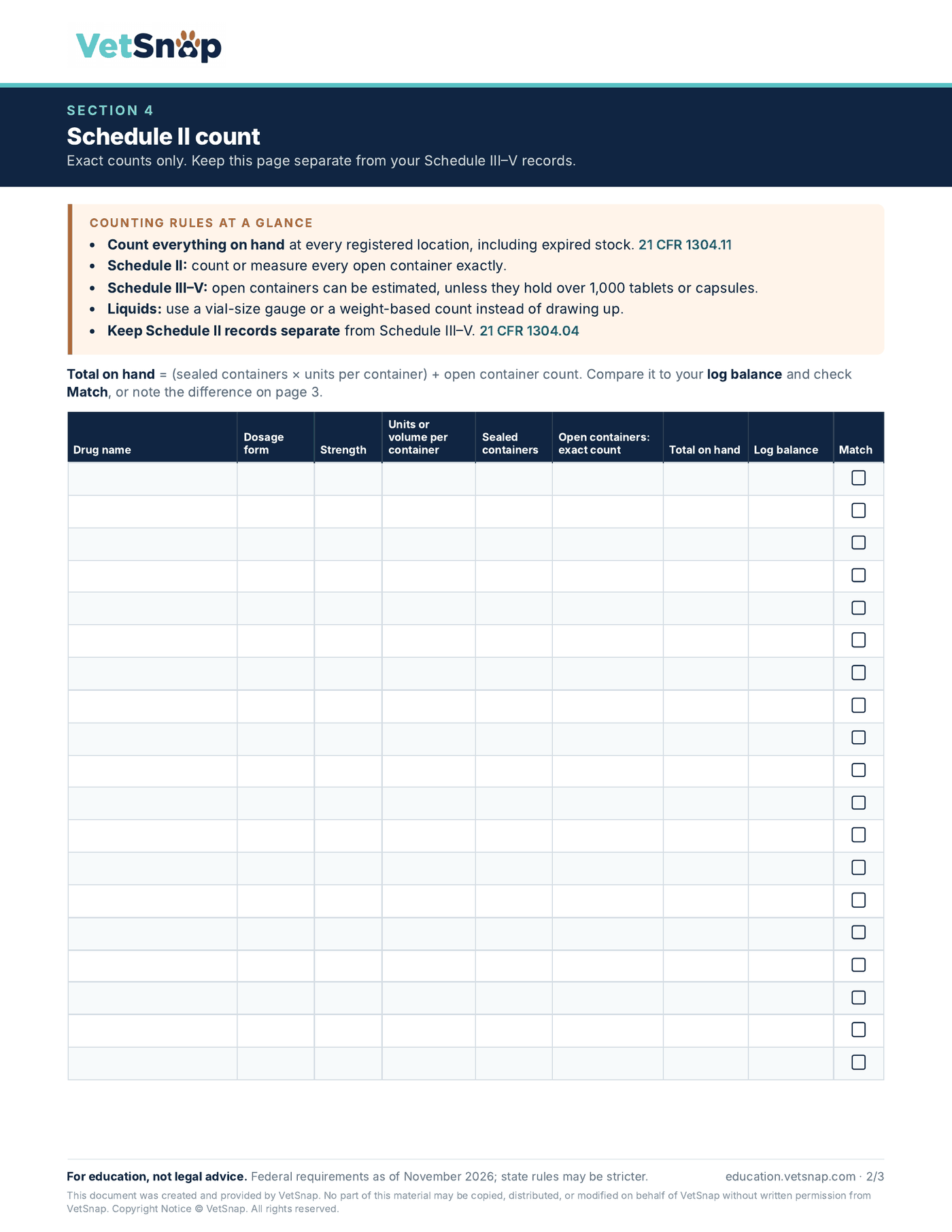
Not on VetSnap? Our printable worksheet has the record header, count tables by schedule, a location checklist, and signature lines.

VetSnap EDU
Go deeper with free, RACE-approved courses
On-demand DEA compliance courses from VetSnap EDU, including Preparing for a DEA Audit. Explore VetSnap EDU →
Start now, start the year clean
The count takes an hour or two. The prep takes a few weeks, so the best time to start is now. Before any audit, our expert asks practices to have three things ready:
- Your biennial
- Your purchase records
- A finished, signed count
For education, not legal advice. Federal requirements as of November 2026; state rules may be stricter.
Share this guide
FREE 30-MINUTE DEMO
Make your biennial a review, not a rebuild.
- See a biennial count in VetSnap
- Get answers about your own setup
Trusted by over 3,000 veterinary hospitals
YOUR NEXT STEP
Make January 1 your easiest count yet.
See how VetSnap handles your biennial, from the first count to the final signature, in one quick call. Trusted by over 3,000 veterinary hospitals.
Still exploring? Get answers, see your workflows, and find the right setup, pricing, and add-ons.
Ready to sign up? Confirm a few details and we’ll get you started right away.
© 2026 VetSnap · For education, not legal advice.